


by Scott Ingleton
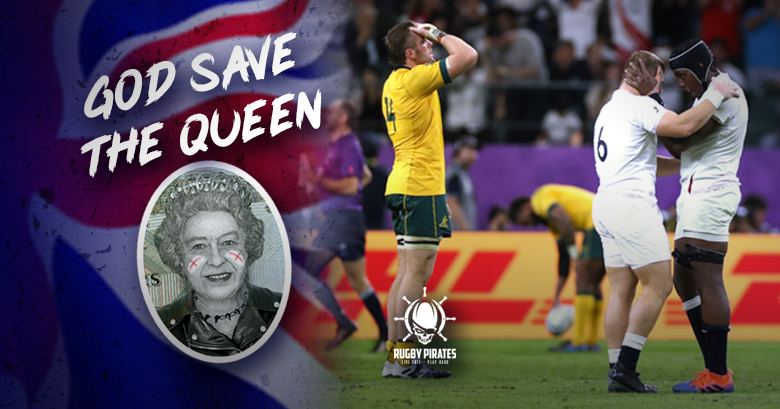
There’s a saying we have in England, that possession is nine tenths of the law. In rugby terms, this means the team with more possession should – in theory – win the match. The quarterfinal played under the Sapporo dome put that theory to the test, and threw convention from the field. England dominated Australia, accurately assessing what they would do at almost every turn, with only 36% possession. This defensive display was not only superb to watch, it was also a very good indicator that England can contain attack based sides. But could they contain an All Black onslaught?
The first points scored – as with many England matches in this World Cup – came from an Australian penalty in the 10th minute, the Wallabies taking the lead. Seven minutes later, England dive over the line through Johnny May after a passage of fast phase play from a line out, securing a lead that would not be lost for the next 63 minutes. This kind of clinical finishing would come to be a clear contrast between the two sides, with England scoring tries through May, Sinckler (off a delightful Farrell flat ball) and Watson. If we focus on the Watson try we can begin to understand what happened with Australia, and how England so adeptly weathered the gold storm.
Three weeks ago, we saw Wales play an interesting game plan against the Wallabies. Multiple times, the electric Gareth Davies would shoot out of the line, looking to intercept or – at the very least – disrupt a long pass from Genia or Beale. If you look at the try the Welshman scored that day, it is almost a snapshot of the try Anthony Watson scored in the 75th minute. The Australian coach Michael Cheika decided not to alter his general game plan from that day, and consequently England were able to read what the wallabies were attempting to do. The Australian attacked relies on quick ball, not giving opponents room to breathe and forcing mistakes once teams are exhausted of constantly moving back in defence. With big runners like Kerevi and like lightning pace of Hodge, Koroibete and Beale on their side when this game plan works it creates some beautiful rugby (just look at their recent victory against the All Blacks). But once teams are clued into this game plan of quick phase/offload play, it becomes fairly simple to disrupt (just look at their recent scoreless defeat to the All Blacks).
Let’s look at the breakdown, where Australian flankers Michael Hooper and David Pocock excel. Often, the Wallabies will look to get a turnover from a lone runner, and either win the penalty (if in their own half) or use it quickly (in the opposition half), allowing them to either clear their lines or attack an unformed defensive line. Under the Sapporo dome, the England forward pack did not allow this to happen, conceding only eight turnovers to Australia’s eighteen. Every runner was supported, which is such a fundamental part of rugby but often not put into practice. Just look at the 31st minute – Curry forces a turnover after a pick and go by Michael Hooper. Youngs takes and passes to George, who unleashes Watson on the near side. Watson is tackled almost into touch by Koroibete, and so attempts to offload back to George. However, the ball goes behind George, meaning he has to dive on it to retain possession. This is where the quality comes in; George has three gold shirts surrounding him; all rugby logic says that Australia should get this ball back. However, Petaia does not hold George in the tackle, allowing him to get back to his feet, thus giving the industrious Itoje an extra second to speed into the new ruck formed when Kerevi holds George. Curry then comes in to assist (bear in mind, these two players were the ones who won the turnover just moments before) and England can form the 3 2 2 attack line, ending in a mediocre clearance by Farrell. Thus, Australia lose an attacking opportunity and must run from deep yet again. This work rate and desire to retain the ball was a key difference between the sides. Throughout the passage of play, the only gold shirts really doing anything were backs – the forward pack was elsewhere and anonymous, the infamous honey badger himself nowhere to be seen.
In addition, the English kicking game was phenomenal. Most kicks were looking to pin the back three just in front of their own 22 – not far enough to allow a mark to be called, and knowing the Australian game plan favours running the ball, it looked like the wallabies would tire themselves out, constantly running from deep in order to retain possession. The Aussies made over twice the amount of runs as England did at 153 compared to 71, and made over double the amount of metres at 578 compared to 275. Beale and Koroibete combined ran 274 metres, almost the same as the entire England team, with only Koroibete’s try to show for their efforts. England scored over double the points scored by Australia for half the metres run; showing sometimes, the best offence is a solid defence.
England well and truly controlled the quarterfinal opponents in a professional manner that will be tested to the limit against an enthralling All Black side. That semifinal is looking to be a contest between an unstoppable force and an immovable object, and it’s going to be a spectacle. Nonetheless, Australia’s World Cup is over, as are the international careers of David Pocock and Will Genia, two legends of the sport who perhaps deserved better send off. Regardless, England prove their worth under the Sapporo time, and the next encounter is shaping up to be a fascinating clash.