


 Like the first paragraph of an essay, or the first 30 seconds of a speech, the first match in a World Cup is often a statement of intent. For France, you may have heard “yeah, we are that team” after their stalwart resistance of an impetuous Argentine resurgence. New Zealand said “that cup is ours and it will remain ours” after their convincing defeat of a very strong South African side. But what did the men from England say, that night under the Sapporo Dome?
Everyone expected England to win against Tonga. The question was always how, not if, and suffice it to say the how has been heavily viewed as disappointing. Yes, England won and yes, they got the bonus point, we knew that would happen. But only with 47% possession? 14 handling errors? 10 penalties conceded? Where has all this come from? England at times looked befuddled (just look at the England team after that big hit by Zane Kapeli on Billy Vunipola in the 12th minute, they look shocked) and nothing like the game dominating side that dismantled Ireland and Italy. They looked frustrated (see Farrell at almost any point in the second half) and often dazed (that ‘move’ by Vunipola and Itoje that gifted Tonga a penalty in the 23rd minute).
However, as an England fan, I am not worried. There are plenty of positives to take; Daly looked comfortable under the high ball (especially pertinent given how often the ball was lost forwards); the lineout is still exceptional, George and Cowan-Dickie providing excellent ball for Itoje and Lawes; the squad depth means that when the entire bench had come on against Tonga he team lost no quality and gained fresh legs; and the English defensive line is superb. To concede only 18 points over 240 minutes of rugby (or even 50 points over 400 minutes) is an outstanding achievement, albeit with mismatched opposition. That works out at a point conceded every 8 minutes, meaning to win an average match England only need a converted try and two penalties, or four penalties, or a try and two drop goals… you get the idea. Winning games is simple – just score more than your opponent. But being able to keep your opponent from scoring tries, or rather more than able but downright great, is a fantastic base from which to launch the rest of this World Cup campaign.
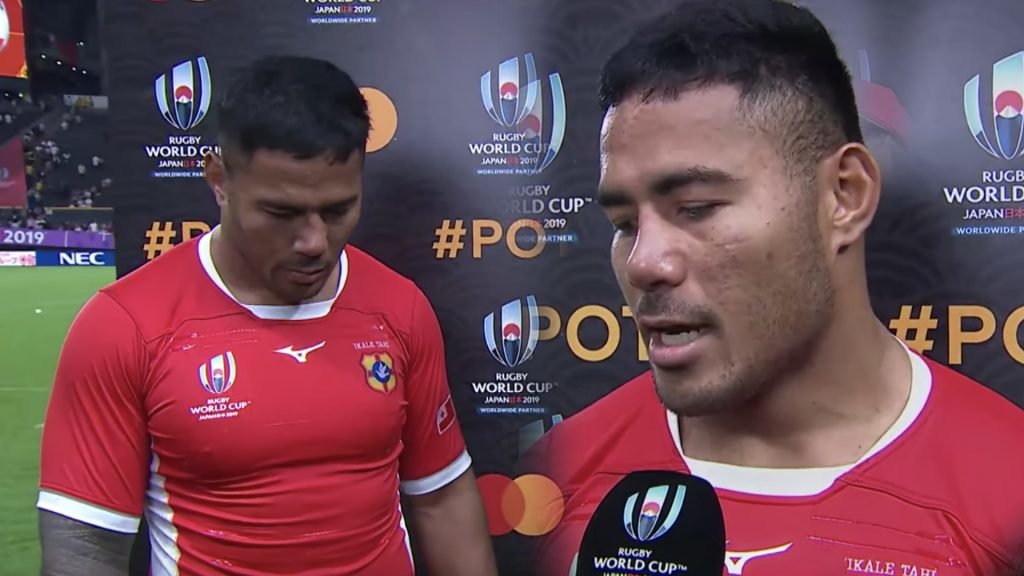
Speaking of scoring tries, you need look no further than the aptly dubbed Manu Two-ilagi. Scoring two tries and heavily involved in Sam Underhill’s try attempt (a try were it not for some exceptional tryline defence by Piutau and Vaipulu), the man of the match winner was a force to be reckoned with the whole night. We all know Tuilagi as a wrecking ball centre, and such a player was certainly needed against a team who relish in the physicality of the game. When Kapeli smashed big Billy Vunipola 12th minute, Tuilagi smashed Tane Takulia three minutes later, saying “you hit hard, we hit harder.” That is the kind of statement England needed to make on a much larger scale in the Sapporo.
Nonetheless, England’s attack (when they weren’t losing the ball forwards) was fairly solid. Two set pieces resulted in tries (from a scrum and lineout maul) and two breaks from May and replacement Joseph got the other two. For someone with not much gametime recently, Joseph looked to be as strong as ever with his break against Tonga. It was vintage JJ; pick a line between a forward (in this case Talakai) and a centre (Vuna); run sideways to stretch them and cause a gap while focusing on the player you can pass it to (in this case, Luke Cowan-Dickie); note that the prop isn’t agile enough to catch you, so you only need the centre to focus on Cowan-Dickie for a moment, and seize the gap. Joseph is a master at this move, and seeing its utility off the bench is certainly another boon for England.
As I have stated, that everyone ‘knew’ England would beat Tonga. This is not to disparage an excellent showing by the Tongans, especially off the back of that huge defeat to New Zealand. In fact, perhaps it was because of that heavy defeat, just look at Ireland. They suffered a heavy loss to England which highlighted huge flaws in their gameplan, and have been unbeaten ever since, dispatching Wales twice and Scotland. They looked completely in charge against Scotland, a dominant Ireland reminiscent of the team that beat the All Blacks last year. Perhaps it has been similar with Tonga, with New Zealand exposing the weak points in the Tongan game, and them then working on them. Against NZ, Tonga attempted 113 tackles, but only successfully made76 of them. Hence, tackling is clearly an issue. They worked on it, and against England they made 93 out of 121 attempts, a 10% increase in success. Against NZ, the only won 6 of their 8 lineouts. Against England, they won 14 out of 15. They had on all their scrums, and even won more ducks than England did (78 compared to 70). Tonga are a small island nation with a population that could almost fit into Wembley, and a budget that is dwarfed by the financial behemoth that is the English Rugby Union, but credit where credit is due. They came out and played with all the raw emotion and passion that we have come to expect from the Pacific Islanders, and it is a disservice to say ‘England should have won by more.’ Tonga proved able opponents at the very least, and they will say much more before the tournament is over.
Many were disappointed by England’s performance. I would say different; I was impressed by Tonga, and I saw areas for England to work on (keeping the ball in hand and discipline among others) but nothing that truly worried me. England had less possession but never looked uncomfortable. They looked stable in defence, structured in attack and never looked like conceding a try against a team that even scored against the All Blacks. Tonga made a much larger statement than England did last night; they are not here to be point farms, they are here to play their way and they will not just keel over. England, on the other hand, are stuck behind the curtain, waiting to announce their arrival.